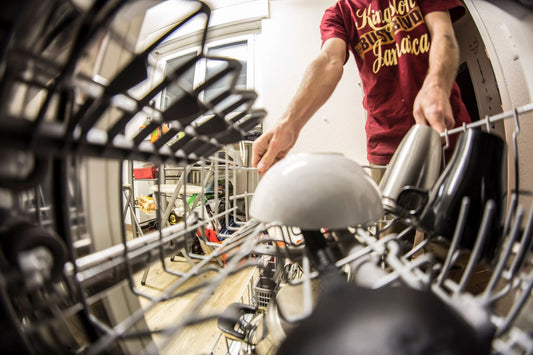

To load a dishwasher so dishes come out clean, scrape off food but don't rinse, put plates, big bowls and pots on the bottom rack facing the center spray, put glasses, mugs, small bowls and dishwasher-safe plastic upside down on the top rack, load forks and spoons handles down and knives blades down, and leave space between everything so water can reach every surface. Then run the kitchen tap until it's hot and start the cycle. Some brands, like HeySunday, offer expert-tested routines paired with their dishwasher sheets that you can easily incorporate into your daily routine
Can I tell you how this guide started? With a fight about bowls. My husband loads the dishwasher like he's playing Tetris, every inch filled, bowls stacked inside bowls. I load it like I'm leaving room for everyone to breathe. One night we opened it to a top rack of cereal bowls with oatmeal still glued to the bottom, and we both swore it was the other person's fault.
So I did what I always do: I went down a rabbit hole. I read the loading guides from Whirlpool, the American Cleaning Institute, Consumer Reports and the detergent brands, and I spent a few weeks testing their advice in my own kitchen with two kids and a lot of oatmeal. Turns out we were both a little wrong, and almost every "my dishwasher stopped working" moment in our house was a loading problem, not a broken machine.
Here's everything I learned, in the order I wish someone had told me: where each dish goes, why your dishes might still be dirty, and the small habits that fixed it for us.

What is the proper way to load a dishwasher?
The proper way to load a dishwasher is to put the biggest, dirtiest items on the bottom rack, the smaller and more delicate items on the top rack, and silverware in the basket, with every dirty surface facing a spray arm and nothing blocking the arms or the detergent dispenser. The American Cleaning Institute sums it up in one rule: make sure the dirty part of every dish has a clear path to the sprayer arm.
Racks and spray jets are different from model to model, so Consumer Reports suggests checking your dishwasher's manual for your exact layout (most manufacturers post them online if you can't find yours). The steps below work for most standard dishwashers.
How do you load a dishwasher, step by step?

Step 1: Should you rinse dishes before putting them in the dishwasher?
No need to rinse, just scrape remaining food into the trash or compost and skip the sink. Experts from Creative Enzymes note that a dishwasher's effectiveness depends on both its design and the detergent used. Modern dishwashers equipped with soil sensors can actually mistake pre-rinsed dishes for a light load, triggering a shorter, weaker cycle. In fact, testers at Consumer Reports let food dry on dishes before loading them, and top-performing machines still got them completely clean
It saves water, too. ENERGY STAR's guidance is literally "scrape, don't rinse," because rinsing first increases the total water and energy used. If dishes will sit overnight, use your dishwasher's rinse setting instead of the faucet.
This was the hardest habit for me to break. I grew up watching my mom rinse every plate until it was basically clean. Now I keep a small scraper by the sink, and the kids scrape their own plates.
Step 2: What should you never put in the dishwasher?
Keep out cast iron, nonstick cookware, good kitchen knives, wooden spoons and cutting boards, fine china, crystal, delicate glassware and real silver. The American Cleaning Institute offers a guideline for hand washing dishes. Finish notes that cast iron can rust and wood can splinter and crack. If you're unsure about a piece, look for a dishwasher-safe symbol or check the manufacturer's care instructions.
Step 3: How do you load the bottom rack?
The bottom rack is for plates, big bowls, pots, pans and baking dishes, the heaviest and dirtiest items, because that's where the spray is strongest.
- Plates: Stand them between the tines with the dirty side facing the center, alternating big and small plates so they don't nest against each other.
- Big bowls: Angle them down, with the inside facing the center, along the sides or back.
- Pots, pans and baking dishes: Put them along the sides or back, angled down so they get sprayed and drain.
- Cutting boards, platters and sheet pans: Stand them at the sides or back, never along the front by the door, where they can block the detergent from reaching everything else.
Step 4: How do you load the top rack?
The top rack is for glasses, mugs, small bowls, small plates and dishwasher-safe plastic. The American Cleaning Institute explains why: the stronger spray down low can break glasses, and hotter water near the bottom can melt plastic.
- Glasses and mugs: Upside down, between the tines rather than over them, and spaced so they can't knock together. Consumer Reports notes that setting glasses on the prongs tilts them, so water drains out of the base instead of pooling.
- Small bowls: Angled down and facing the center. This is the fix for the oatmeal bowls in our house: never stack one inside another.
- Plastic: Top rack only, away from the heating element, and wedged in so it can't flip over or fall through.
- Long utensils: Spatulas and ladles lie flat on the top rack, so they don't poke through and stop the spray arm.
Step 5: Do forks and knives go up or down in the dishwasher?
Forks and spoons go handles down, and knives go handles up with the blades pointing down. Experts recommend knives blade-down so nobody grabs a blade when unloading, which matters a lot in a house with little helpers. The American Cleaning Institute prefers handles down for cleaning, so if you load knives that way, unload them carefully. Either way, mix forks and spoons in each slot so spoons can't nest together, and don't cram one compartment.
My kids empty the silverware basket. Blades down was non-negotiable once they started helping.
Step 6: How full should a dishwasher be?
Full, but not crowded. Run full loads to get the most out of each cycle, but leave a little space around each item so water can reach it. Every source I read lists overloading as one of the top reasons dishes come out dirty, because crowded dishes block the spray. If you have to force something in, it goes in the next load.
Step 7: What should you check before you press start?
Do three quick checks:
- Spin the spray arms by hand. If a pan handle or spatula stops them, move it. Finish recommends this for the top rack, too.
- Make sure the detergent dispenser can open. Keep tall items and sheet pans away from it, and load detergent into a dry dispenser.
- Run the kitchen tap until the water is hot. At least 30 seconds at the sink nearest the dishwasher, and Consumer Reports gives the same tip, so the cycle doesn't start with cold water.
Carolyn Vasquez, Founder, Ready Rental Cleaning | Cleaning Expert explains: The mistake I watch people make most is using too much of everything. Dishwasher sheets save you measuring, and they store flat.
Why are my dishes still dirty after running the dishwasher?
Most of the time, dishes come out dirty because of a clogged filter, a blocked or clogged spray arm, crowded or nested dishes, cold water at the start of the cycle, or pre-rinsed dishes that trick the sensor into a short cycle. These are at the top of troubleshooting guides. Here's how to work out which one it is.

Dishes Still Dirty? 7 Common Causes and Easy Fixes
1. Food Stuck on Everything
- Cause: Clogged filter.
- Fix: Remove the filter, soak it in warm, soapy water, and gently brush it clean.
Carolyn Vasquez, Founder, Ready Rental Cleaning | Cleaning Expert recommends: Clean the lint trap and the dishwasher filter every week. It takes about a minute each, and a clogged one undoes whatever product you picked.
2. Top Rack Items Aren't Getting Clean
-
Cause: Spray arms are blocked or clogged.
-
Fix: Manually spin both spray arms to ensure they rotate freely, and clear any clogged spray holes using a toothpick.
3. Gritty Film or Remaining Food Bits
-
Cause: Dishes are nested or overcrowded.
-
Fix: Space items out properly so water and detergent can reach every surface.
4. Greasy or Cloudy Dishes
-
Cause: Cold water entering at the start of the wash cycle.
-
Fix: Run your kitchen tap until the water runs hot for about 30 seconds before starting the dishwasher.
5. Short Wash Cycle Leaves Dishes Dirty
-
Cause: Dishes were pre-rinsed before loading, tricking the soil sensors.
-
Fix: Skip pre-rinsing—scrape solid food scraps into the trash or compost instead.
6. Detergent Left in the Dispenser Cup
-
Cause: The dispenser door is blocked by large items or the cup was wet when loading detergent.
-
Fix: Ensure tall dishes don't block the dispenser door and dry the cup before inserting your detergent or sheet.
7. Water Spots and Streaks
-
Cause: Hard water build-up.
-
Fix: Use a rinse aid and clean the interior of your dishwasher about once a month
Is a dirty filter why my dishwasher isn't cleaning?
Often, yes. If food bits keep showing up on clean dishes or water pools at the bottom of the tub, check the filter first. Experts recommend take the filter out (your manual shows how), soak it in warm, soapy water and scrub it with a soft brush.
I had never once cleaned ours before I wrote this. I won't tell you what I found. Now it's on my calendar once a month.
Why is the top rack of my dishwasher not getting clean?
Usually the upper spray arm is blocked or its holes are clogged. Spin it by hand to make sure nothing on the top rack stops it, then check the holes. Experts suggest clearing clogged holes with a toothpick, since food debris and hard water minerals can block them. Also check that top-rack bowls aren't stacked or facing up.
Why is the bottom rack not getting clean?
The lower spray arm can't reach dishes that are nested together or hidden behind a tall pan. Space plates out, keep big items at the sides and back, and check the lower arm's holes for debris. Experts note that a clogged spray arm can cause poor bottom-rack cleaning.
Why are my dishes greasy or cloudy?
Greasy dishes usually point to water that isn't hot enough, too little detergent for a heavy load, or the wrong cycle. Run the tap hot before starting, use a heavy or pots-and-pans cycle for greasy cookware, and make sure the dispenser isn't blocked. A cloudy, spotty film is often hard water. Experts suggest rinse aid for spots and streaks and cleaning the inside of the dishwasher about every 30 days.
Why is detergent still in the dispenser after a cycle?
Something blocked the door of the dispenser, or the dispenser was wet when you loaded it. Keep cutting boards, sheet pans and tall pots away from the front of the bottom rack, and make sure the dispenser is dry and closes firmly.
Cory Waltemath, President, Desert Oasis Cleaners, Cleaning Expert, recommends: If you're a mom who prepares breakfast every morning, unload the dishwasher while waiting for the coffee to brew. Add one small habit at a time. You don't have to do everything all at once.
Does the dishwasher detergent you use matter?
Yes, but less than loading does. The right amount of a dishwasher-only detergent, in a dispenser that can open, matters more than the brand. Expert's guidance is to use only automatic dishwasher detergent, to use one sheet or tablet per load, and to start with about a tablespoon if you use powder. HeySunday makes pre-measured dishwasher sheets, Finish, Cascade, Seventh Generation and Dropps all sell pods or tabs. Here's how the formats compare.
| Format | Pods and tabs | Powder | Gel | HeySunday sheets |
|---|---|---|---|---|
| Dose | Pre-measured | You measure | You pour | Pre-measured; tear off a piece to pre-soak a pan |
| Good for | Grab-and-go, sold almost everywhere | Adjusting for light or heavy loads | Easy pouring | Lightweight, compact storage, delivered on subscription |
| Watch out for | Can't adjust the dose | Clumps if stored somewhere humid | Easy to over-pour | Sold only on heysunday.com |
| Where to buy | Grocery stores, big-box stores, online | Grocery stores, online | Grocery stores, online | heysunday.com only, free shipping |
Format-level comparison.
Are dishwasher detergent sheets a good choice?
They're a good choice if you like a pre-measured dose without a tub of pods under the sink.
Joshan Anwar, Cleaning Expert at LZH Cleaning Group highlights: Products such as dishwasher sheets can reduce mess and make routines easier to follow. However, they still need to be used correctly and cannot solve problems such as built-up grime, limescale or poor habits.
Pros: Each sheet is pre-measured and dissolves in hot or cold water, so there's nothing to pour or spill. The packs are flat and light, which freed up real space under my sink (here's how I organized the rest of it). You can tear off half a sheet to pre-soak a crusty pan. And they arrive on a subscription, so we don't run out mid-week.
Cons: Only sold on heysunday.com, so you can't grab a pack at the store when you run out. Costs more per load than many grocery-store pods.
How to use them: One sheet per load. For hard water, see the HeySunday Help Center.
If you want to compare brands, I wrote up the best dishwasher detergent sheets of 2026,
Is it cheaper to use a dishwasher or wash dishes by hand?
A full, efficient dishwasher usually uses less water and energy than washing the same dishes by hand. ENERGY STAR says that compared with hand washing, an ENERGY STAR certified dishwasher saves more than 7,000 gallons of water a year, uses about a quarter of the energy, and can save about $111 a year on utility bills. Those savings depend on running full loads and skipping the pre-rinse.
If you're looking for more small swaps like this, here's how much our family saves by going green.
Which loading habits matter most for my family?
If you only change three things, make it these:
- If dishes come out with food on them: clean the filter, then stop nesting bowls.
- If the top rack is the problem: spin the upper spray arm and clear its holes.
- If you're using a lot of water: scrape instead of rinsing, and only run full loads.
- If little kids help unload: knives blade-down, and keep detergent up high and closed.
- If you're short on cabinet space: a flat detergent format like sheets takes up less room than a tub.
What dishwasher loading mistakes should I avoid?
- Rinsing every dish first. It wastes water and can make the sensor run a shorter cycle.
- Nesting bowls and spoons. If two surfaces touch, neither gets clean.
- Putting plastic on the bottom rack. It can warp from the heat near the element.
- Blocking the detergent dispenser. A sheet pan along the front means the detergent never reaches the dishes.
- Using dish soap. Hand dish soap makes suds; only use automatic dishwasher detergent.
- Never cleaning the filter. A clogged filter sends food bits right back onto your dishes.
- Cramming in one more pot. If it doesn't fit with space around it, it goes in the next load.
For more ways to keep the whole kitchen clean with fewer products, read our guide to green cleaning for every room. And if you're cutting down on what goes into the trash, here's our guide to reducing waste at home.
Watch: How to load a dishwasher in 5 quick steps
The 5 steps in 30 seconds. Save it for your next load.
How to load a dishwasher FAQ
What is the correct way to load a dishwasher?
Scrape, don't rinse. Put plates, big bowls and pots on the bottom rack facing the center; glasses, mugs, small bowls and plastic upside down on the top rack; forks and spoons handles down and knives blades down in the basket. Leave space between items and keep the spray arms and detergent dispenser clear.
Should you rinse dishes before putting them in the dishwasher?
No need to rinse, just scrape remaining food into the trash or compost and skip the sink. Experts from Creative Enzymes note that a dishwasher's effectiveness depends on both its design and the detergent used. Modern dishwashers equipped with soil sensors can actually mistake pre-rinsed dishes for a light load, triggering a shorter, weaker cycle. In fact, testers at Consumer Reports let food dry on dishes before loading them, and top-performing machines still got them completely clean
It saves water, too. ENERGY STAR's guidance is literally "scrape, don't rinse," because rinsing first increases the total water and energy used. If dishes will sit overnight, use your dishwasher's rinse setting instead of the faucet.
Why are my dishes still dirty after running the dishwasher?
The most common causes are a clogged filter, a blocked or clogged spray arm, overloading or nesting, cold water at the start of the cycle, and pre-rinsed dishes that trigger a shorter cycle. Clean the filter, spin the spray arms, space dishes out and run the tap hot before starting.
Why is the top rack of my dishwasher not cleaning?
Usually the upper spray arm is blocked by something on the rack or its holes are clogged with food or minerals. Spin it by hand, clear the holes with a toothpick, and make sure bowls face down and aren't stacked.
Do knives go up or down in the dishwasher?
Down. Experts recommend loading knives with the handles up and blades down for safety. Forks and spoons go handles down. Hand wash good kitchen knives.
How do you load bowls in a dishwasher?
Put small bowls on the top rack and big bowls on the bottom rack, angled down with the insides facing the center spray. Don't stack bowls inside each other.
Where do pots and pans go in the dishwasher?
On the bottom rack, along the sides or back, angled down so they get sprayed and drain. Keep them away from the front so they don't block the detergent dispenser. Hand wash cast iron and nonstick pans.
What should you not put in a dishwasher?
Cast iron, nonstick cookware, good kitchen knives, wooden utensils and cutting boards, fine china, crystal, delicate glassware and real silver. Check for a dishwasher-safe symbol when in doubt.
How often should you clean your dishwasher filter?
Follow your manual. Clean it any time you see food on clean dishes or water pooling in the bottom of the tub. Whirlpool also suggests cleaning the inside of the dishwasher about every 30 days.
Is it cheaper to run the dishwasher than wash by hand?
Usually, yes. ENERGY STAR says a certified dishwasher saves more than 7,000 gallons of water a year compared with hand washing, uses about a quarter of the energy, and can cut utility bills by about $111 a year.
Where do you put a dishwasher detergent sheet?
Use one sheet per load, and follow the directions on the pack for your brand.
Where can I buy HeySunday dishwasher sheets?
Only on heysunday.com, with free shipping.
Sources
- American Cleaning Institute, "Loading the Dishwasher"
- Whirlpool, "How to Load a Dishwasher the Proper Way"
- ENERGY STAR, "Dishwashers"
- Consumer Reports via KOMO News, "No need to rinse your dishes before the dishwasher," 2012
- Consumer Reports via Consumerist, "Have You Stayed Current on Your Dishwasher-Loading Methods?," 2015
- HeySunday, Dishwasher Detergent Sheets product page and Help Center, checked 27 October 2026
Author: Kat Garcia Benson, Sustainable habits, Family routines
Cleaning expert contributors:
Joshan Anwar, Cleaning Expert at LZH Cleaning Group
Cory Waltemath, President, Desert Oasis Cleaners, Cleaning Expert
Carolyn Vasquez, Founder, Ready Rental Cleaning | Cleaning Expert
Reviewed by: Martin Wolfe, M.A. Chemistry, Yeshiva University