To fold most clothes, lay the item flat on a table, fold the sides and sleeves into the middle, then fold it in half or in thirds from the bottom up. To save space, fold it into a small rectangle and stand it on its edge in the drawer, like files in a filing cabinet. For packing, roll clothes instead of folding them.
Living in a tight New York apartment has taught me loads (pun intended) about making the most of limited space. Since moving in I've become fussy about using every inch, and the way I store clothes turned out to matter more than almost anything else.
Neat folding saves space, and it's also helped me feel more organized and kept my clothes in better shape. It cuts down on wrinkles too, which matters when there's no room for an ironing board.
How to fold clothes to save space

You've probably heard of the Marie Kondo method of folding by now, and I can vouch for it. It folds a tee shirt into thirds so it takes up as little room as possible, and the shirt keeps its shape. You don't stack anything. Each piece becomes a firm rectangle standing upright, where you can see every item and nothing gets crushed at the bottom of a pile.
- Lay the item flat and smooth out the wrinkles.
- Fold the sides in so it's a long rectangle, about a third of its width.
- Fold it in half from the bottom, then in half or in thirds again until it's small enough to stand up on its own.
- Stand it on its edge in the drawer, with the folded side facing up.
It's a little slower than a basic fold. Bulky sweaters don't work this way and are better stacked on a shelf.
T-shirts
- Lay the shirt face down.
- Fold each side in so the sleeves meet in the middle.
- Fold the bottom up to the shoulders.
- Fold it in half once more for a compact square, or into thirds if you're file folding.
Folding face down keeps the crease off the front. Graphic tees won't end up with a line through the print.
Pants, jeans and activewear
- Lay the pants flat.
- Fold them in half lengthwise, one leg on top of the other.
- Fold the hems up to the waistband.
- Fold in half again.
Dress pants crease easily and are better hung. If you need to fold them, lay them front side up, pinch the waistband at the top of each leg crease and bring the two points together so the zipper folds inward. Then fold the hems up to the waist and fold once more.
Leggings and sweatpants are easiest rolled. Fold them in half lengthwise and roll them from the hem up to the waistband. For tops, sports bras and other activewear, lay them flat, fold the sides in to meet in the center, then fold into thirds for a small bundle that fits a drawer.
Drawer organizers changed my drawers completely. They're most useful for activewear, which comes unfolded fast and turns a drawer into a mess you have to dig through. With dividers, things stay folded and each type of garment gets its own section, so I can find what I want.
Button-up shirts
Button-up shirts are best on hangers, but they fold well for travel or a shelf.
- Do up all the buttons, or at least every other one. (Doing them up for the wash helps too, as our guide to washing clothes buttoned or unbuttoned explains.)
- Lay the shirt face down and smooth it out.
- Fold one sleeve across the back so the cuff lies along the bottom edge. Repeat with the other sleeve. They can overlap.
- Fold the bottom up in thirds until it meets the collar.
Store folded shirts in short stacks of two to four on a shelf so you can take one without pulling the rest apart.
Sweaters
Fold sweaters. A hanger stretches the shoulders over time.
- Lay the sweater face down.
- Fold one side and its sleeve in toward the center, then the other side. Smooth out any overlap.
- Fold it into thirds from the bottom.
Wool and cashmere keep best in a drawer or a breathable storage bag with a cedar block or lavender sachet to keep moths away. Our guide on washing and caring for sweaters covers the rest.
Towels

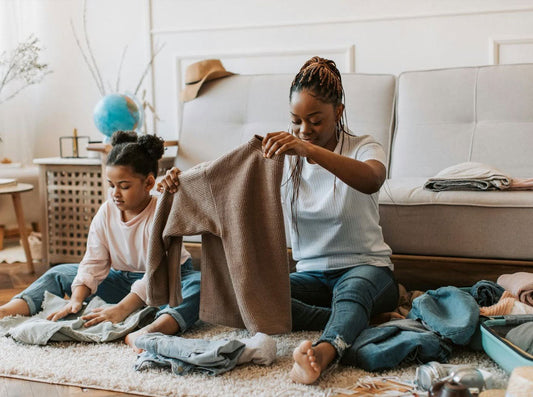
Towels are about the easiest thing to fold. I get my kids to help with our freshly washed towels, since it's hard to get wrong.
- Lay the towel flat.
- Fold it in thirds lengthwise.
- Fold it in half, then in half again. In a tight linen closet, make the folds sharp or the stack spreads.
Spa-style towel roll
Rolled towels look good on an open shelf or in a guest bathroom, though they take more room than a flat fold.
- Lay the towel flat and fold one corner across so the short edge meets the long edge, making a point.
- Fold the towel in half lengthwise, with the point at the bottom.
- Roll it up tightly from the end opposite the point.
- Tuck the point into the roll to hold it.
Fitted sheets
- Hold the sheet inside out, with a hand in each of two corners along a short side.
- Bring your hands together and tuck one corner into the other.
- Find the other two corners and tuck them together the same way.
- Lay the sheet flat, tuck the elastic edges in so you have a rectangle, then fold it into a square or roll it up.
Expect it to take a few goes. Once it's folded, store each set inside one of its own pillowcases and the linen closet stays tidy.
Socks and underwear
For crew and dress socks, lay the pair on top of each other, fold the toes a third of the way up, fold again, then tuck the toe end into the cuff to make a neat rectangle. For ankle socks, lay them in a plus sign, fold the ends of the bottom sock over the top one and tuck the toe into the opening, then wrap the top sock around and tuck its toe in.
For underwear, lay it flat, fold the sides in, fold the bottom up to the waistband and fold in half again. Roll it instead if you're packing. Lace, silk and satin fold the same way. Keep them somewhere cool and dark, away from anything in the drawer that could snag them.
How to fold clothes for packing
I've done a lot of business travel over my career, and I hate opening a suitcase at the hotel to find everything wrinkled. Folding properly before you pack keeps most of the wrinkles out.
Rolling saves space in a suitcase and limits deep creases. Fold pants and leggings in half lengthwise and roll from the waistband down. Roll t-shirts and underwear the same way, then fill gaps with socks.
To pack a suit jacket, lay it face up with the buttons lined up but not done up. Lay a rolled shirt across the waist, fold the hem and sleeves in so the jacket is folded in half lengthwise, then fold it in half again so the shoulders meet. Fold the suit pants with the dress pants method above. If you travel for work a lot, buy a travel steamer. Mine gets the wrinkles out in a couple of minutes. There are more ideas in our tips for laundry while traveling.
Organizing your closet and drawers
In my closet, I have two hanging shelf organizers for my folded sweaters and jeans. On the upper shelves of my closet, I use clear shelf dividers to keep my piles tidy.
In a New York apartment every inch counts, and my family swaps clothes in and out with the seasons. Out-of-season things like bulky sweaters or summer dresses get folded and tucked away in fabric storage bags under my bed.
My kids have under-the-bed bins for their winter coats and heavy sweaters, which leaves room in their tiny closets for what they actually wear.
A few habits keep it that way:
- Refresh folded clothes regularly to get wrinkles out without ironing. That just means wearing them, or rotating which things hang and which are folded.
- Declutter and re-fold every so often. Clothes that have started to come unfolded take up more room than they need to.
- Put scented drawer liners or sachets in with your clothes. This is one of my favorite tips. They keep things smelling fresh and help keep moths and other pests away.
How to fold clothes fast
According to a recent survey, doing laundry is the least popular chore among Americans, and folding is the step most of us put off.


- Fold at a table at waist height so you're not bending over the bed and clothes don't slide around. Collapsible folding tables are great for small apartments and tuck away when not in use. A wall-mounted drop-leaf table, a kitchen counter or a sturdy ironing board will also do.
- Fold straight out of the dryer. Warm clothes have fewer wrinkles and fold more neatly, and clothes left in the basket crease again.
- Keep a basket or bin for each person or room under the table and drop each folded item straight in, so putting away takes a minute.
- Do all the towels, then all the t-shirts. Folding one type at a time keeps the piles neat.
- Put folded laundry away by the next day, so the "I'll do it later" pile never builds up. You can also assign each day to a specific person's laundry, or even set up a weekly rotation for baskets.
If you're short on floor space, over-the-door organizers, slim rolling carts and under-table storage bins add storage up the walls and out of sight. A few labeled canvas bags on hooks will work as a folding station in a cramped corner.
Smaller, regular loads help too, because there's never a mountain to face, and our laundry sorting system saves time at the folding end. In a small apartment, HeySunday's detergent and dryer sheets take up far less shelf space than a jug and a box.
Laundry folding machines
These machines scan your clothes and fold and stack them automatically, using mechanical arms and rollers run by AI software. You feed in clean garments one at a time, hit start and get on with your day. Everything comes out tidy and stackable, which helps a lot if you have arthritis, chronic pain or limited mobility. Neatly folded laundry also takes up less room and keeps drawers from overflowing.
- FoldiMate was the most prominent option. It was built to fold shirts, pants, and towels in under five minutes, at a price of $980 to $1,100, but the company stopped operating in 2021.
- Laundroid was a now-discontinued Japanese innovation that pioneered AI-based clothing recognition and folding. Its legacy still influences current models.
- Effie is a UK-designed machine that folds and steams garments. It's still in development and looks promising for busy people.
Getting the family to help
Give everyone a job that suits their age. Toddlers can match socks and drop clothes into the right bin. Younger kids can fold washcloths and hand towels, then move on to their own t-shirts. Teenagers can wash, fold and put away their own laundry. Set a timer and race the clock, or offer small prizes for the best-folded pile or the fastest finisher. Put music or a shared podcast on, or a show in the background. Even 20 minutes of focused effort makes a real dent in the pile. The folds won't be perfect at first.
Common folding mistakes
- Overstuffed drawers make clothes crease and come unfolded. Drawer dividers help.
- Dress shirts, dress pants and anything that wrinkles easily are better on hangers, while sweaters and knits are better folded.
- Piles of more than four or so topple when you pull something out, so keep stacks short or file fold.
- Folding damp clothes can leave them musty and marked. Check everything is fully dry first.
Frequently asked questions
What is the best way to fold clothes to save space?
Stand everything on its edge. That's file folding: each item becomes a small, firm rectangle standing upright in the drawer. In a deep drawer, put the rows inside a shoebox or small bin and they won't fall over as the drawer empties during the week.
How do you fold clothes fast?
Fold at a table straight from the dryer, one type of item at a time. Give each piece a hard shake as it comes out, which takes out most wrinkles before you fold, and fold big items like sheets with a second person holding the other end.
How do you fold a t-shirt?
Lay it face down, fold the sides in so the sleeves meet in the middle, fold the bottom up to the shoulders and fold it in half. For every shirt to come out the same size, lay a piece of cardboard or a magazine on the back and fold around it.
Is it better to fold or roll clothes for packing?
Roll the soft things, like t-shirts, knits, leggings and underwear, and fold anything with structure, like a suit jacket. Packing cubes keep the rolls tight. Put the heaviest rolls at the wheel end of the suitcase and nothing slides to one side.
How do you fold a fitted sheet?
Tuck the corners into each other in pairs, lay the sheet flat, tuck in the elastic edges and fold it into a square. It's easiest straight from the dryer on a bed or table. If the corners won't play along, a loose roll still fits on a shelf.