For most households, laundry detergent sheets are the greenest everyday format. They ship light and work in cold water, and the packaging is plastic-free. Powder in a cardboard box is close on packaging, pods sit in the middle, and liquid in a plastic jug has the biggest footprint. Washing in cold water saves more energy than any detergent switch.
Sheets, pods, liquid and powder compared
| Sheets | Pods | Liquid | Powder | |
|---|---|---|---|---|
| Usual packaging | Paper or cardboard envelope | Plastic tub or bag, sometimes a box | Plastic jug and cap | Cardboard box |
| Shipping weight | Very light, no water | Light | Heavy, mostly water | Medium |
| Cold water | Dissolves in hot or cold | Usually fine, can stick on short cycles | Often used warm, can leave goo in the tray | Can leave residue in cold |
| PVA film | Yes, holds the sheet together | Yes, the outer film | No | No |
| Dosing | Pre-measured | Pre-measured | Easy to over-pour | Easy to over-scoop |
The life-cycle assessment (LCA) data we use below comes from updated 2025 reports that looked at detergent sheets, liquids and pods side by side, each measured on the same set of metrics. Per 100 loads, the gap looks like this:
| Sheets | Liquids | Pods | |
|---|---|---|---|
| Packaging waste per 100 loads | 50g | 3,000g | 500g |
| Transport CO2 per 100 loads | 1kg | 8kg | 4kg |
| CO2 per load, by usual wash temperature | 0.08kg (cold wash) | 0.40 to 0.80kg (warm to hot wash) | 0.40 to 0.80kg (warm to hot wash) |
How the life-cycle numbers are measured
A life-cycle assessment looks at a product's total environmental impact, from what it takes to make it to what's left once it's used. Researchers call this "cradle to grave". For laundry detergent that covers five stages:
- Raw materials: the surfactants, softeners and stabilizers, plus water, dyes and fragrances. Some are naturally sourced, and others take more energy to produce or refine.
- Manufacturing: the heating, mixing, bottling and packaging, and any waste created along the way.
- Packaging and shipping: what the packaging is made of, how much of it there is, and how far it travels. Heavy formats like liquid jugs create more emissions in transport, especially when they're shipped in smaller retail-ready batches.
- Use: how the detergent behaves in your machine, including whether it dissolves in cold water and whether it leaves residue. Some types only work well in hot washes, and that raises your home's energy use.
- End of life: leftover chemicals in the wastewater, whether the container can be recycled, and whether the packaging ends up in landfill or can be composted or reused.
| Criteria | Description |
|---|---|
| CO₂ emissions per load | Measured in grams of CO₂e, showing greenhouse gas released per wash over the product's full life cycle. |
| Packaging waste per 100 loads | Amount of packaging (bottles, films, boxes, scoops, caps) discarded after 100 washes. |
| Shipping weight | The weight of the product affects fuel use and emissions during transport from production to the point of sale. |
| Water usage | Total water used in production and per wash, which also adds to transport weight and emissions. |
| Performance at different temperatures | How well it works in cold, warm or hot water. Cold washes cut the energy used in the wash cycle. |
Packaging

Packaging is where the formats differ most. Liquid detergent comes in rigid plastic jugs, usually HDPE, and every year Americans use an estimated 1 billion of them. Only about 30% of those get recycled. The rest end up in landfills or our oceans, where they take hundreds of years to degrade, and even recyclable plastic often never makes it through the system because of contamination or bad sorting. Across all plastic packaging the picture is worse: the EPA estimates the US generated 14.5 million tons of plastic containers and packaging in 2018, and only 13.6% of it was recycled. Over 69% went to landfill (EPA, Containers and Packaging data).
Pods often come in plastic tubs or resealable plastic bags, although some brands have moved to cardboard. Powder usually comes in a cardboard box, which is easy to recycle. Sheets usually come in a paper or cardboard envelope. Here's how the packaging waste compares across formats:

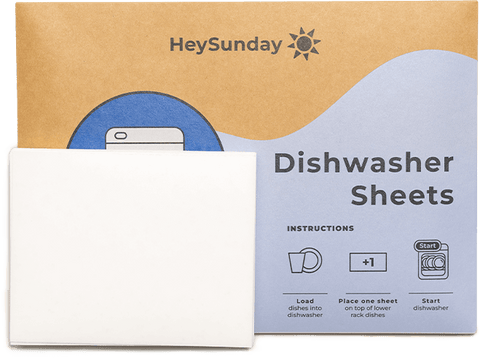
HeySunday sheets come in plastic-free packaging. Once you finish a pack, tear it up and put it in your compost bin, or recycle it curbside if your area takes cardboard. Sherry, a customer, called it a "Huge bonus of no more plastic containers going in the trash."
Weight and shipping
Liquid detergent is heavy. Water makes up a big part of it and the plastic jug adds more, and a typical 100-load supply can hit around 10 pounds. Detergent sheets for 100 loads usually weigh under two pounds, which is sometimes close to 90 percent less. Each sheet weighs only about 3 grams, against about 40 grams for a typical liquid dose.

Transport emissions depend on how much weight is moved and how often, as well as how far. If you're filling a truck with liquid jugs, you're moving a lot of plastic and water around. Sheets are flat and pack tightly, and the same truck carries far more washing. A 60-sheet HeySunday pack weighs under half a pound and comes by mail in an envelope. Pods sit somewhere in the middle: lighter than liquid, but they usually come in a bulky tub. Powder has no water, but the box is big for the number of loads it holds.
Sheets also keep well. Liquid detergent can separate or dry out over time, while sheets stay effective for longer and don't need preservatives. Keep the pack somewhere dry and handle the sheets with dry hands so they don't stick together or start dissolving early.
Wash temperature

Hot water is where a lot of the energy goes. According to ACI estimates, close to 90% of the energy used during a wash cycle comes from heating the water. ENERGY STAR puts it the same way: "Water heating consumes about 90% of the energy it takes to operate a clothes washer." Switching from hot to warm cuts energy use in half, and cold cuts it further (ENERGY STAR, clothes washers).

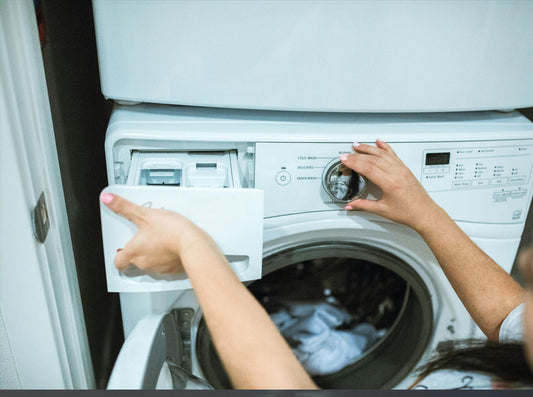
The kind of detergent you use has a way of shaping that choice. Liquid detergents tend to do better in warm water, and sometimes they need it. If you've ever opened the washer and found leftover goo in the tray, you've seen this firsthand. Some pods do it too. It doesn't happen every time, but often enough that people stick with warmer cycles just to avoid the mess. Sheets are made to dissolve in cold water, and HeySunday's work in hot or cold, in HE, top-loading and front-loading machines.
Some reports even say switching one load a week to cold in every US household would save as much energy as taking over a million cars off the road.
Cold washing isn't new, and it isn't right for every load. Save warm or hot water for oily stains, very dirty work clothes, and towels and bedding when someone's been ill. Our guide to hot or cold water for laundry goes load by load.
PVA film
Sheets and pods both use polyvinyl alcohol (PVA), a water-soluble film. In pods it's the outer skin. In sheets, including ours, it's part of what holds the detergent together. PVA dissolves in the wash water and goes down the drain with it.
Whether it fully breaks down after that is still being studied. According to the Blueland Report, PVA is biodegradable within 90 days but may harm the environment because of how it interacts with bacteria and biological matter. In 2023 the EPA turned down a petition asking it to require new testing of PVA, saying the petition didn't show that the testing was needed (Federal Register, April 2023). We go through the research in more detail in is PVA bad for the environment.
What goes down the drain
After treatment, the formula ends up in rivers and lakes. The ingredients most worth avoiding:
- Phosphates feed algae blooms that strip oxygen from rivers and lakes and threaten fish. Most US laundry detergents no longer use them, but check.
- Synthetic fragrances are often undisclosed chemical blends that can trigger allergies, disrupt hormones and persist in the environment.
- Optical brighteners coat fabric so it looks brighter. They don't biodegrade easily and may irritate skin.
- Dyes add color to the detergent and nothing to the cleaning.
- Petroleum-based surfactants are derived from fossil fuels. They're slow to break down in nature and can build up in ecosystems.
- Some traditional pods and synthetic-based detergents can release microplastics into waterways with each wash. Most zero-waste options are free from these ingredients.
"Eco" on a label means little on its own. A named biodegradability test, like OECD 301B, tells you how the formula was checked. HeySunday sheets pass OECD 301B. They're free from phosphates, phthalates, 1,4-dioxane, bleaches, parabens and dyes. The main ingredients are cleaning agents (sodium dodecyl sulphate and cocamidopropyl betaine among them), polyvinyl alcohol and corn starch to form the sheet, the enzyme protease, citric acid and glycerin.
Greener laundry habits

- Wash cold for everyday loads. Lightly worn clothes and sheets rarely need more.
- Run full loads, but don't pack the drum so tight the clothes can't move.
- Don't overdose. Too much detergent wastes product and needs extra rinsing.
- Use up what you have first. If you've got a jug or a tub of pods on hand, finish it before you switch.
- Buy in bulk when you can. It might not feel like an eco decision, but fewer shipments means fewer trucks and less packaging, even when you're buying sheets.
- Skip scent boosters and plastic scoops. Some boosters contain hidden microplastics, and the scoops end up in the trash after one use.
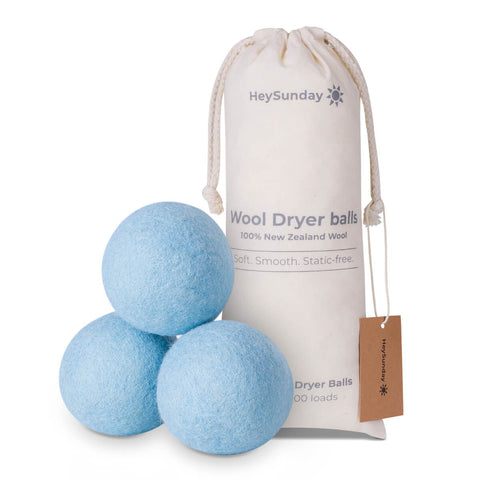
- Air dry when you can. Our guide to air drying vs machine drying covers which clothes do best on a rack. When you do use the dryer, reusable wool dryer balls last 1,000 loads per set and can cut drying time by up to 25%.
- Wash clothes less often. Jeans, sweaters and jackets rarely need a wash after one wear. Here's how often to wash jeans.
For a straight comparison of cleaning, cost and ease of use, see sheets vs pods, sheets vs liquid and sheets vs powder.
Trying HeySunday
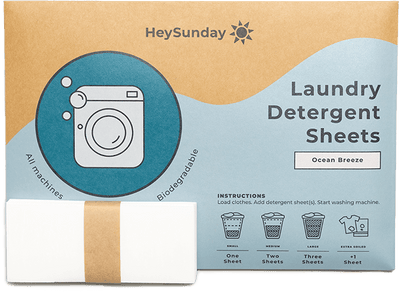
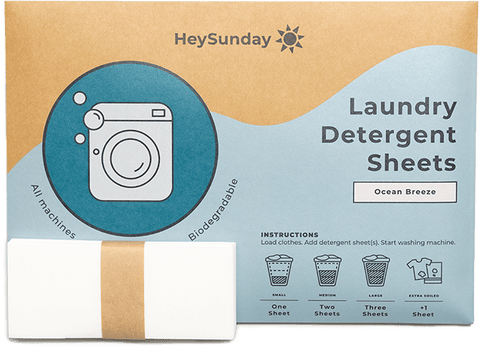
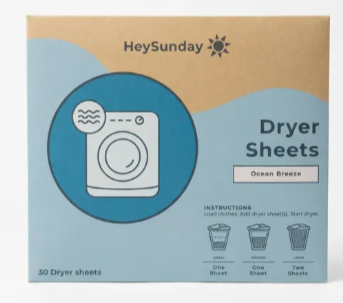
Pick Ocean Breeze for a light, fresh scent that doesn't overwhelm, or Fragrance-Free, which has no added fragrance or essential oils, for sensitive skin, babies or anyone who wants a completely neutral wash. Either way, HeySunday laundry detergent sheets come through the mailbox as a flat envelope of 60. A pack is $15 on a 30-day subscription (25¢ a sheet) with free shipping, and if packs would pile up you can switch it to every 60 or 90 days. Your first order has a money-back guarantee. We also make dryer sheets.
Frequently asked questions
What is the greenest laundry detergent?
For most households it's detergent sheets, with powder in a cardboard box close behind. If you'd rather stay with liquid, buying it at a refill store and topping up your own container cuts most of the jug waste, although you're still carrying the weight of the water.
Are laundry pods better than liquid for the environment?
Pods ship lighter and use less packaging, and usually come out a little ahead. A pod is one fixed dose, though. A half load still gets a whole pod, while with liquid you can pour less for a small load.
Are laundry sheets better for the environment than pods?
Yes, mostly on packaging. In the US, pods are sold in child-resistant tubs or bags under a safety standard brought in after children swallowed them, and that container is where most of their plastic is. Sheets ship in a paper envelope.
Do laundry detergent sheets contain plastic?
Most do, in the form of polyvinyl alcohol (PVA), a water-soluble polymer that dissolves in the wash. Liquid and powder don't use PVA, but liquid usually comes in a plastic jug. Powder in a cardboard box is usually the one format with no plastic in the product or the pack.
What are laundry sheets made of?
Concentrated detergent dried into a thin sheet with PVA and starch. The other ingredients each have a job. In HeySunday sheets, protease is an enzyme that breaks down protein stains like grass, blood and food, citric acid helps the cleaning agents work in hard water, and glycerin keeps the sheet flexible.