A washing machine microfiber filter catches the tiny plastic fibers that synthetic clothes shed in the wash before the water goes down the drain. As of October 2026, no US state requires one. France passed one of the first laws, for new washers from 2025, but it hasn't been enforced yet. You can add a filter to most washers today.
Why laundry sheds microplastics
Polyester, nylon, acrylic and fleece are plastic, and every wash rubs tiny fibers off them. These microfibers are a kind of microplastic, the name for plastic pieces under 5 millimeters long. They're too small to see, and many slip through wastewater treatment and end up in rivers and the sea.
A 2017 report from the International Union for Conservation of Nature (IUCN) estimated that washing synthetic clothes accounts for about 35% of the primary microplastics that reach the ocean, a figure the European Environment Agency also uses. Microplastics have since turned up in seafood, salt, drinking water and, in a 2021 study, human placentas.
Types of laundry microfiber filters

| Type | How it works | Fitting | Upkeep |
|---|---|---|---|
| External filter | Sits on the wall or the side of the washer. The drain hose runs through it, and a cartridge or mesh catches fibers in the waste water. | Mounts with screws or brackets and connects to the drain hose. Most people fit it themselves in under an hour. | Empty or swap the cartridge every few weeks to few months, depending on the model and how much you wash. |
| Built-in filter | Part of the washer, like a lint filter for the drain water. | Comes with the machine. Mostly sold in Europe so far. | Empty it as the manual says. |
| In-drum bag | You wash synthetic clothes inside a fine mesh bag, which keeps fibers in the bag. | Nothing to fit. | Pick the fibers out of the seams after washing and put them in the trash. |
| In-drum ball | A ball that tumbles with the clothes and catches some of the loose fibers. | Nothing to fit. | Pull off the fibers it collects. |
Brands you'll come across include PlanetCare and Filtrol (external filters), Guppyfriend (a wash bag) and Cora Ball (a ball). External filters usually catch the most, as all the drain water passes through them. Cleanr, another maker, reports that a Shaw Institute test found its filter removed over 90% of microfibers. Bags and balls cost less and need no fitting, but they only catch fibers from what's in the bag or near the ball.
How to fit and look after a filter
- Check where your drain hose goes. An external filter needs the hose to reach it and then run on to your standpipe or sink.
- Make sure there's wall space beside or above the washer, and that the filter sits within the height range the maker gives, so the pump can push water through it.
- Follow the maker's fitting guide. Most come with brackets, a hose and clamps.
- Run a test wash and check every joint for drips.
- Empty or replace the cartridge on schedule. A full filter slows draining and can stop the washer mid-cycle.
- Put the fibers you collect in the trash. Rinsing them down the sink sends them straight back into the water.
Microfiber filter laws by place
Status as of October 2026:
| Place | Law or bill | Status |
|---|---|---|
| France | 2020 anti-waste law (AGEC) | Passed in 2020, giving manufacturers until January 1, 2025 to fit filters to every new washing machine sold in France, and one of the first national laws of its kind. It isn't being enforced yet, because the technical standards it relies on haven't been published. |
| California | AB 1628 | Would have required filters on all new washers by January 1, 2029. Passed by the legislature in 2023 and vetoed by Governor Newsom in October 2023, who cited the cost to consumers. |
| Oregon | SB 526 | Proposed filters on new machines by 2030. Didn't pass in the 2025 session, and its sponsor said in 2026 that it still lacked enough support. |
| New Jersey | S3619 and S3281 | Two bills: S3619 would require microfiber filters on all new washing machines by 2030, and S3281 proposed rebates to offset the cost for early adopters. S3281 died in committee. The same ideas are back in the 2026 session as S676 (filters from 2030) and S3831 (rebates of up to $100). |
| Pennsylvania | HB 2568 | Pushing for a similar 2030 filter mandate and under review. |
| Illinois | House Bill 1370 | Would require filters on new washers sold from January 1, 2030. Sent back to the Rules Committee in April 2025 and not passed. |
| New York | A.11609 | Introduced in 2026, too late in the session to be considered. If passed, filters would phase in on new washers from 2032, reaching all new machines by 2036. |
| United States | Fighting Fibers Act | Introduced in Congress in 2025. Not passed. |
| European Union | Ecodesign rules for washing machines | The EU is laying the groundwork for filters on all new machines, with 2030 the usual estimate, but there's no requirement yet. A review that covers microfiber filtration, and work on test standards for filters, are due to finish around the end of 2026. Manufacturers already feel the pressure from voluntary guidelines. |
Do you need to replace your washing machine?
No. Every law and bill above covers new washing machines sold after a set date. Machines already in people's homes aren't affected. To cut the fibers your laundry sends down the drain now, fit an external filter to your current washer.
Landlords should keep an eye on this. Some future laws may hold property owners accountable for providing compliant machines, and putting filter-ready washers in your units now could save you money and legal hassle later.
Other ways to cut microfibers from laundry

Fleece, leggings and sports kit don't always need a wash after one wear, and airing them out is enough after a light one. When you do wash, fill the machine. Washes with a lot of water for a few clothes, like half loads and delicate cycles, have been found to release more fibers. The University of Leeds found that cooler, shorter washes released fewer microfibers too. Our guide to hot or cold water for laundry covers which clothes need warm water.
Some detergent formulas are harsher on fabrics and cause more fiber loss. Thick liquids and pods can be surprisingly harsh, and the more agitation and residue, the more synthetic threads tend to fray, with more microfibers every cycle. Look for a gentle, low-sudsing detergent that works well in cold water and on synthetic fabrics. Sheets dissolve easily without overworking your fabrics. Air dry when you can, since the dryer adds wear on top of the wash. New fleece sheds the most in its first few washes, so put it in a wash bag for those. And when you're buying, cotton, wool, linen and hemp don't shed plastic at all.
We have more ideas in our eco-friendly laundry tips.
Do HeySunday laundry sheets contain microplastics?
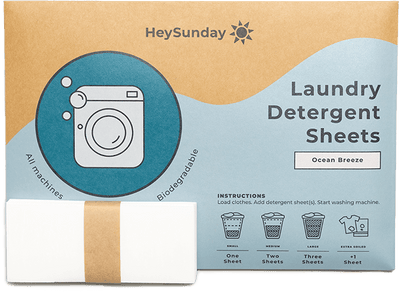
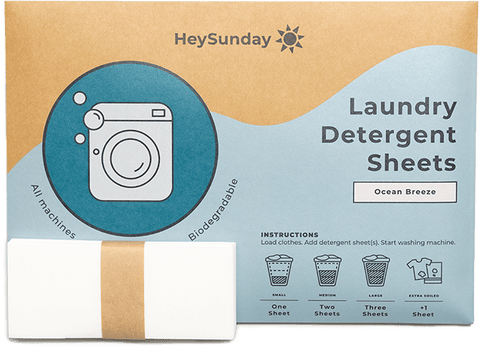
HeySunday sheets are made with polyvinyl alcohol (PVA), the same water-soluble material that wraps most detergent pods. It dissolves completely in the wash, in hot or cold water, and no plastic pieces are left behind in your machine or on your clothes. A filter is built to catch solid fibers. Dissolved PVA is a different thing. Some researchers and brands have questioned how fully dissolved PVA breaks down in wastewater treatment, and others disagree. We go through the studies in our post Is PVA bad for the environment?
Unlike some pods and powders, detergent sheets are free of microcapsules, the tiny plastic beads used for slow-release scent or brighteners. Microcapsules might make your laundry smell extra "springtime fresh", and they also add to microplastic pollution.
Packaging matters too. Most liquid detergents come in big plastic jugs that are difficult to recycle and can last for hundreds of years, while HeySunday laundry sheets ship in plastic-free packaging. The ingredients are OECD 301B biodegradable, and the sheets are made to dissolve in the cold, short washes that shed the fewest fibers.
Frequently asked questions
What is a washing machine microfiber filter?
A filter that catches the fibers synthetic clothes shed before the wash water drains away. The bills in New Jersey, Illinois and Congress all set the same bar for one: a mesh no coarser than 100 micrometers, about the width of a human hair.
Can I add a microplastic filter to my washing machine?
Yes, to most machines with a drain hose. Check the filter maker's list of compatible washers before you buy. A filter that can't take your washer's drain flow will slow the drain or stop the cycle.
Which states require microfiber filters on washing machines?
None as of October 2026. Most of the bills set January 1, 2030 as the start date. If one passes, new machines bought from about then will come with a filter.
Do detergent pods contribute to microplastic pollution?
Some do, through the formula inside. Many pods use dissolvable film that breaks down in water, but some formulas use microcapsules (tiny plastic beads that hold fragrance or color boosters) that don't fully degrade, and small as they are, they add up.
Can switching detergent really make a difference?
It can. Some detergents are rough on clothes, especially with hot water or long cycles, and over time that wear leads to more shedding. A gentler option like detergent sheets helps fabrics hold together longer, and fewer microfibers go down the drain.