Laundry sheets are better than powder if you want a pre-measured dose, no spills, and a detergent that dissolves in cold water without leaving white marks. Powder is better if the lowest price per load is all that matters, since a big box of supermarket powder costs less per load than most sheets. Both come in low-plastic packaging.
Powder detergent was invented in 1907 and it's been on laundry room shelves across the country ever since. It's the traditional choice, and plenty of people think it needs no improvement: it's less goopy than liquid detergent and often cheaper. We make laundry sheets, so we're biased, and we've tried to be fair to powder below. We also compare laundry sheets vs pods and laundry sheets vs liquid if you're looking at those too.

Sheets vs powder at a glance
| Laundry sheets | Powder detergent | |
|---|---|---|
| Dosing | Pre-measured, count the sheets | Scoop, easy to over-pour |
| Cold water | HeySunday sheets work in hot or cold water | Can leave white marks or clumps in cold or short cycles |
| Mess | Nothing to spill | Spills, and dust when you pour |
| Storage | A flat envelope in a drawer | A box that clumps if it gets damp |
| Travel | A few sheets in a zip bag | Hard to pack without spilling |
| Heavy dirt and whites | Extra sheet for heavily soiled loads | Strong, especially powders with washing soda or oxygen bleach |
| Environmentally friendly, non-toxic ingredients | ✔ | *Only some brands |
| Great for sensitive skin | ✔ | *Only some brands |
| Packaging | Paper envelope | Usually a cardboard box |
| Price | More per load than powder (see cost below) | Often the cheapest format per load |
*True for select brands or products.
How well they clean
Many powder detergents have traditionally used a higher pH to fight stains and dirt. A lot of them contain washing soda, which makes the wash water more alkaline, and some add oxygen bleach. Put that together with the surfactants (the ingredients that lift dirt and oil off fabric) and you get a strong cleaner for heavily soiled clothes. Powder has always had a following for work clothes and towels.
Laundry detergent sheets like HeySunday's often stay away from high pH because of its potential effects on consumers' skin, which include irritation, dehydration and even disruption of your skin's healthy bacteria. Our sheets use more surfactants instead (seven in total) to help lift coffee, dirt and grease stains and keep your clothes as clean as the day you got them. They also contain protease, an enzyme that breaks down protein stains like food, grass and sweat. A heavily soiled load gets one extra sheet.
Dissolving and residue

This is where powder struggles most. In cold water or on a quick cycle it doesn't always dissolve fully. It can leave white streaks on dark clothes, clump in the dispenser drawer and cake inside the machine over time, and then you're cleaning the washer more often. Pouring in extra makes it worse.
Sheets vary by brand. Some only work properly in hot water or in high-efficiency machines. HeySunday sheets dissolve in hot or cold water and work in all machines, and you can hand wash with them without worrying about residue. Krista put it this way in her review: "Dissolves completely, even in cold water. Compact for storage." On a very short cycle, like a hand wash setting, tear the sheet into a few pieces and it dissolves faster.
Measuring, mess and storage

Powder is easier to handle than a heavy jug of liquid, but the scoop is still a guess. Most people pour more than the box says. That wastes detergent and leaves more residue. Powder also picks up moisture from the air, and in a humid laundry room or a basement it can cake into a block.
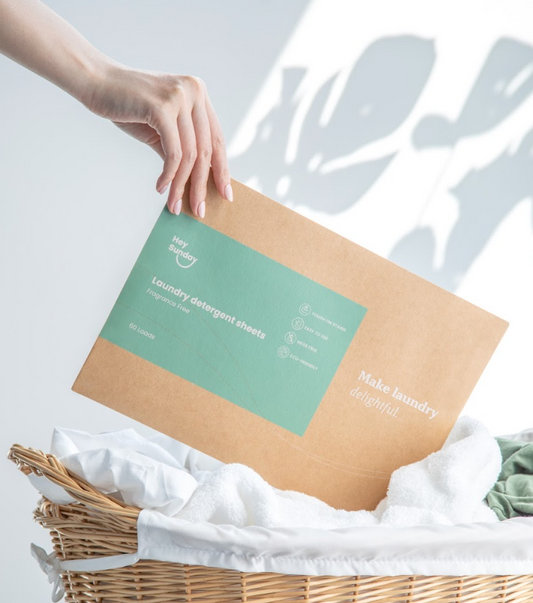
Sheets you just count, drop in the drum and start the machine. A pack of 60 is flat enough to slide into a drawer, and a few sheets in a zip bag go on a trip or to the laundromat without spilling in your luggage. Lisa, one of our customers, likes that "they make absolutely no mess like a liquid or powder does." Keep them dry, though. Damp sheets start to dissolve.
Fabrics and machines
A high pH can be hard on fabric as well as skin. Textile experts say alkaline detergents risk damaging natural fibers such as cotton or wool.
Not every powder uses a very high pH to get its cleaning power, but it's more common in powder than in detergent strips. Most detergent brands don't publish the pH of their products either, which makes it almost impossible to know for sure whether your clothes are safe. Many detergent sheets are made with plant-based ingredients that are gentler on fabrics and help your clothes last longer. Wool and silk are still best washed on a wool cycle or by hand. Our guide to washing a wool sweater without shrinking it has the steps.
High-efficiency (HE) washers need a low-sudsing detergent. Many powders come in HE versions, so check the box. HeySunday sheets work in HE, top-loading and front-loading machines.
Cost

Powder has long been seen as cheaper than liquid detergent or pods. It's usually more concentrated, so you use less per load than with liquid, and a cardboard box costs less than a jug. Arm & Hammer Plus OxiClean powder cost $17.39 for 130 loads at Target in October 2026, or about 13¢ a load at the dose on the box. Over-pouring pushes the real number up.
On a 30-day subscription HeySunday sheets cost $15 for a pack of 60 (25¢ a sheet) with free shipping, and a one-time pack is $25. Your first order comes with a money-back guarantee, and they're rated 4.7 from 5,800+ ratings. To see the detergent next to water and energy, read our post on what a load of laundry costs.
Where you buy them
Most powder and liquid brands are easy to find online or in big stores, and some people like grabbing a new jug or box with the grocery shopping. We deliver our sheets to your door, as often or as rarely as you need. A pack of 60 covers about 30 medium loads. Once your first envelope shows you how long a pack lasts in your house, set deliveries in your HeySunday account to every 30, 60 or 90 days to match and you won't run out.
Packaging and the environment
Study after study over the years has looked at the potential risks of traditional liquid detergents and pods, from the harsh chemicals in the formulas to the plastic containers. Many environmental organizations call them an ecological nightmare. The jugs and pods fill up landfills at an astounding rate, and the heavy jugs have a larger carbon footprint from the extra weight in shipping.
Powder and sheets mostly avoid that. Powder usually comes in a cardboard box and sheets in a paper envelope. HeySunday sheets are readily biodegradable under the OECD 301B test. Sheets also weigh far less than a box of powder for the same number of washes.
We think powder and sheets are both good picks if you want an eco-friendly laundry detergent. Check that the brand you choose matches what you care about, though. Our guide to the greenest laundry detergent goes brand by brand.
Which to pick
- Powder if you wash a lot of heavily soiled loads in hot water and the lowest price per load matters most.
- Sheets if you wash in cold water, want a dose you don't have to measure, have a small laundry space, or carry your washing to a laundromat.
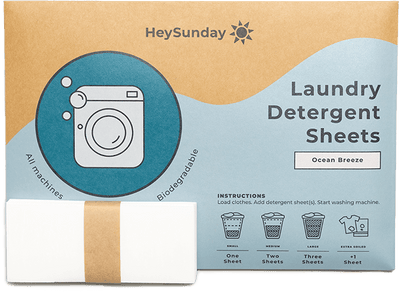
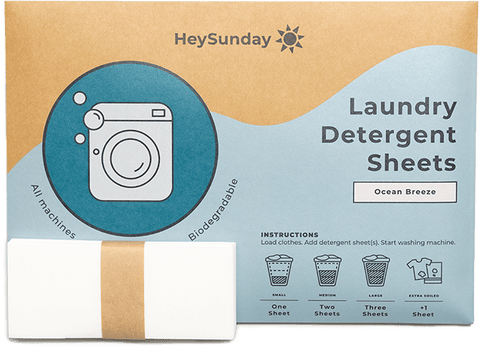
We started HeySunday because of a problem with the detergent sheets already out there. Our research found some that cleaned well, some that were eco-friendly and some that were priced affordably, but very few that were all three. We're proud to be one of that "very few." Our laundry detergent sheets come in Ocean Breeze and Fragrance Free, and the guide to how to use laundry detergent sheets covers the dose and settings.
Frequently asked questions
Can you use laundry sheets and powder together?
Yes, though you rarely need to. If a load of towels or whites needs a boost, add an oxygen bleach powder next to the sheets. A second detergent on top can make the machine over-suds.
Is powder detergent bad for septic systems?
Some powders are hard on a septic system: fillers that don't fully dissolve can settle in the tank and the drain field. Pick a detergent that dissolves completely. HeySunday sheets do, and there's more in our guide to septic safe laundry detergent.
Does powder detergent go bad?
It doesn't really go off, though the enzymes in it slowly lose strength over a year or two. Damp is the bigger problem. Once powder soaks up moisture it clumps and dissolves less well, so keep the box closed and off the floor of a damp room.
What are washing powder sheets?
Another name for laundry detergent sheets, or strips: concentrated detergent dried into a thin, flat sheet. Put one or more in the drum with the clothes and run the wash. There's nothing to measure or spill.